Portland, Oregon has spent several years dealing with difficult headlines, declining confidence, distressed office buildings, public safety concerns, and businesses reconsidering their place in the urban core. Those problems are real. They also do not tell the entire story.
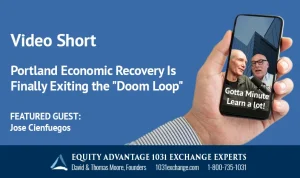
David Moore of Equity Advantage 1031 Exchange recently sat down with Jose Cienfuegos, president of the Revitalize Portland Coalition, to discuss what is changing in Portland and why the current moment may represent a meaningful opportunity for investors, businesses, and property owners willing to take a long-term view.
Cienfuegos is not a career real estate professional. He is an attorney with experience as a public defender, juvenile defense lawyer, prosecutor, and civil practitioner. That outside perspective, combined with his criminal law background, has helped shape his role with the Revitalize Portland Coalition. The organization brings together approximately 10,000 members and 25 companies invested in the future of Portland, Multnomah County, and Oregon.
The central message is simple: Portland needs investment, business activity, housing, redevelopment, and productive real estate transactions. When those things happen, the city gains jobs, revenue, services, and confidence.
Business Is a Partner in Portland’s Recovery
There is often a tendency to treat business growth as separate from community well-being. In reality, the two are closely connected. A city with active businesses, occupied buildings, construction activity, property transactions, and new employers has more resources to address its challenges.
Every commercial real estate transaction creates a wider economic effect. A single sale may involve brokers, attorneys, accountants, lenders, appraisers, inspectors, title companies, escrow officers, contractors, suppliers, and property managers. If the buyer improves or repositions the property, the economic impact continues.
That activity creates revenue. Revenue helps fund public safety, infrastructure, services, and programs for people who need help. Cienfuegos’ point is not that the city can simply tax its way out of a problem. It is that Portland must create the conditions where businesses and investors want to participate again.
“Business is not a bad word,” he says. “It’s a partner.”
The Real Estate Market Has a Pricing Problem, but Also an Opportunity
Portland’s commercial market is dealing with an uncomfortable reality: some buildings are worth less today than they were years ago, even after substantial ownership costs and debt service. Higher interest rates have changed the math on refinancing, particularly for properties financed when borrowing costs were far lower.
For some owners, the concern is not simply market value. It is the possibility of debt exceeding basis, refinancing becoming impossible, or a forced sale creating taxable “phantom gain.” A property may be economically upside down while still carrying tax consequences that make a sale difficult.
Those circumstances are painful for existing owners. They can also create a reset for a new buyer. If a building trades at a price that supports current financing costs and realistic occupancy assumptions, it may once again become workable.
Moore’s investment perspective is straightforward: real estate is generally not a get-rich-quick strategy. It is a get-rich-surely-but-slowly strategy, provided an investor does not put themselves in a position where they must sell during a recession or market downturn.
That principle matters in Portland today. The opportunity is likely best suited to investors who can acquire a property at an adjusted basis, improve it over time, and hold through a recovery rather than expecting an immediate turnaround.
Distressed Buildings May Be Repricing at Levels That Work
One of the most widely discussed examples is the US Bancorp Tower, commonly known as Big Pink. The building reportedly traded for more than $400 million before the pandemic-era market disruption, while a later purchase was completed for approximately $40 million.
The difference illustrates the scale of the repricing occurring in some downtown assets. A lower purchase price does not remove every challenge. Vacancy, tenant improvements, operational costs, and financing remain significant considerations. Yet the replacement cost of a major downtown building is vastly different from the price at which some assets can now be acquired.
For a patient investor, that distinction matters. Buying an existing asset at a discounted price can reduce the uncertainty associated with ground-up development. The structure is already there. The question becomes how to improve it, reposition it, lease it, and operate it effectively.
Cienfuegos compares the current moment to the investment regret people often express years later: “I wish I had bought five years ago.” His argument is that Portland may be in that five-years-ago moment now.
Portland’s Core Assets Have Not Changed
Challenges can obscure the fundamentals that made Portland attractive in the first place. Those fundamentals remain.
- A major river running through the center of the city.
- Access to the coast and mountains from one metropolitan area.
- Green landscapes, long summer days, and a temperate summer climate.
- A highly regarded airport and strong regional connectivity.
- Professional sports, cultural amenities, restaurants, wine country, and outdoor recreation.
- An established design and manufacturing ecosystem in footwear, apparel, outdoor products, knives, optics, and related industries.
Portland is home to major names and specialized businesses across apparel, footwear, outdoor products, optics, tools, and design. Nike, adidas, Keen, Leupold, Gerber, Benchmade, Kershaw, Shun, Leatherman, and others reflect a regional cluster that is easy to overlook when the focus remains solely on downtown vacancy statistics.
The Willamette Valley is another major asset. Oregon wine has drawn substantial investment, and Cienfuegos sees an opportunity to better connect the valley’s growth with Portland’s downtown economy.
Rebuilding Confidence Requires Livability and Enforcement
No city can successfully recruit investment if business owners and residents do not feel confident about daily conditions. Break-ins, vandalism, visible drug use, graffiti, and property crime affect far more than individual victims. They influence insurance costs, leasing decisions, foot traffic, business retention, and the broader perception of the city.
Cienfuegos’ background as both a defense attorney and prosecutor informs his view. He recognizes that many people facing addiction and homelessness need meaningful help. At the same time, he believes livability crimes must be addressed consistently through adequate staffing, law enforcement, prosecutors, and service resources.
He sees progress compared with several years ago. Problems remain, but the public conversation has moved from denial toward identifying problems and developing workable responses. That shift matters because confidence is often the first requirement for recovery.
Downtown activity, including First Thursday in the Pearl District, is one indication that people are returning. The Pearl offers a model worth studying because it combines residents, businesses, restaurants, retail, and walkable density in the same area.
Mixed-Use Redevelopment Can Change Downtown
One major question for Portland is what to do with underused office space. Cienfuegos discussed Jordan Schnitzer’s view that many lower-rise downtown buildings could be rethought or replaced with more useful mixed-use projects.
The goal is not merely to add more buildings. It is to create places where people can live, work, shop, dine, and spend time within a few blocks. That kind of density supports local businesses and makes downtown feel active beyond traditional office hours.
One concept is the “summer birds” idea: attracting people from hotter markets such as Arizona, Nevada, New Mexico, and Texas to spend the summer in Portland. The city’s climate and natural setting could make downtown second homes, seasonal residences, and extended stays more attractive if the right buildings, amenities, and policies are in place.
Waterfront redevelopment is also part of the conversation. Portland has a river, but it has not fully realized the river’s potential as a recreation, transportation, dining, residential, and visitor asset. Successful waterfront projects in other cities offer useful examples, but Portland will need to create its own approach.
Permitting Reform May Be One of the Most Important Changes
For developers, time is money. A project delayed by subjective reviews, inconsistent rules, or lengthy permit timelines accumulates interest expense, carrying costs, and uncertainty before the first tenant ever occupies the property.
This is particularly important for an Improvement Exchange. In a typical 1031 Exchange, an Exchangor has 45 days to identify replacement property and 180 days to complete the acquisition. Improvement Exchange structures can be useful where a replacement property requires construction or upgrades, but permitting delays can make such projects difficult to execute.
Cienfuegos described a more encouraging conversation with Portland’s executive mayor. The mayor reportedly invited stakeholders to identify codes and processes that should be changed to make projects faster, more predictable, and more viable.
Revitalize Portland Coalition is responding by seeking input from real estate attorneys and professionals on a practical “wish list” of code changes. The objective is not to eliminate sensible standards. It is to create predictable rules and shorten the path from an idea to a shovel in the ground.
When a project can be completed sooner, the city benefits sooner. Property taxes, payroll, retail activity, tenancy, and surrounding values can all improve when a productive building replaces an underused site.
What Investors and Businesses Can Do Now
Portland is not without risk. Investors should be selective, understand the specific submarket, evaluate financing carefully, and work with experienced local professionals. A distressed purchase is not automatically a good purchase simply because the price is lower.
Still, the city’s current position may give buyers, developers, and employers more leverage than they have had in years. Cienfuegos encourages those considering a major investment or business relocation to clearly communicate what they need to make the project work.
- What tax structure or incentive would support the investment?
- What permitting changes would reduce unnecessary delays?
- What infrastructure, safety, parking, or transportation improvements are necessary?
- What type of building, lease structure, or mixed-use development is viable?
- What support would make Portland competitive with another market?
For investors considering a 1031 Exchange into Portland, the usual Exchange rules still apply. Replacement property must be identified within 45 days, and the acquisition must generally be completed within 180 days. Early planning is essential, especially when a transaction involves financing, redevelopment, tenant improvements, or a more complex Exchange structure.
Portland’s turnaround will not happen overnight. It will require better public policy, thoughtful redevelopment, consistent enforcement, business recruitment, and people willing to invest in the city’s long-term potential. The encouraging sign is that more of those conversations are now happening at the same table.
Getting Involved
Revitalize Portland Coalition works to educate the public and elected officials, advocate for practical reforms, and connect people who want to contribute to Portland’s recovery. Businesses, property owners, and community members interested in participating can contact the organization through revitalizeportland.com.
For questions about structuring a 1031 Exchange, including delayed, Reverse, or Improvement Exchange considerations, contact Equity Advantage 1031 Exchange at 1031exchange.com.
Portland has real work ahead. It also has real assets, a repriced market, renewed attention to reform, and a growing recognition that progress requires action. For long-term investors, that combination may be worth a closer look.
The Guys With All The Answers…
 David and Thomas Moore, the co-founders of Equity Advantage & IRA Advantage
Whether working through a 1031 Exchange with Equity Advantage, acquiring real estate with an IRA through IRA Advantage or listing investment property through our Post 1031 property listing site, we are here to help Investors get where they want to be. Call them today! 503-635-1031.
Frequently Asked Questions about the Portland Real Estate Market
Why is Portland, Oregon a potential once-in-a-lifetime opportunity?
A combination of factors, including a repriced real estate market, renewed attention to reform, and growing collaboration among public officials, businesses, and community organizations. It suggests this unique mix may be worth a closer look for investors with a long-term perspective.
What should investors remember when completing a 1031 Exchange into Portland, Oregon?
The standard 1031 Exchange deadlines still apply. Replacement property must be identified within 45 days, and the acquisition generally must be completed within 180 days. Early planning is especially important when financing, redevelopment, tenant improvements, or other complex Exchange structures are involved.
What role does the Revitalize Portland Coalition play?
The Revitalize Portland Coalition educates the public and elected officials, advocates for practical reforms, and connects businesses, property owners, and community members who want to contribute to Portland, Oregon’s recovery.
Why is early planning important for a 1031 Exchange?
The article notes that early planning becomes especially important when an Exchange involves financing, redevelopment, tenant improvements, or a more complex Exchange structure, helping investors stay on track with the required timelines.