

Most real estate investors assume that if they lose money on a property, there can’t be a taxable gain. But that’s not always true. An investment property can decline in value, lose all of its equity and eventually go into foreclosure or be sold through a short sale, and the owner may still have taxable gain.
This is known as phantom gain, and it’s something we’ve been talking about for years. It can be particularly surprising because the investor may receive no cash from the transaction. The property is gone. The equity is gone. But the tax consequences may remain.
Here are seven questions every investment-property owner should understand before a distressed property transfers:
1. What is phantom gain in real estate?
Phantom gain can occur when the debt on an investment property exceeds the property’s basis. Gain and profit are not the same thing. For tax purposes, gain is calculated using the adjusted sales price and the property’s basis. An investor can therefore have gain even when a property hasn’t produced an economic profit.
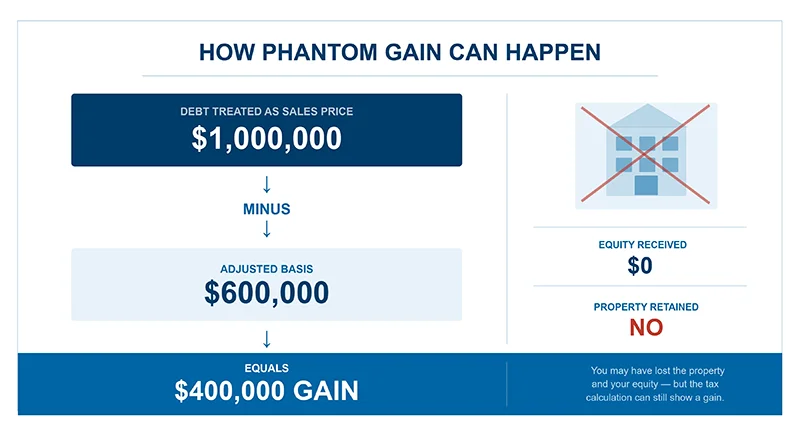
In a foreclosure, the sales price is generally considered to be the debt on the property. If that debt exceeds the owner’s basis, the difference can create taxable gain even though the owner received no cash.
That’s what makes the gain feel “phantom.” The tax calculation shows gain while the investor may have lost both the property and the equity.
2. How can you lose a property and still have gain?
Consider a simplified example.
- Debt on the property: $1,000,000
- Adjusted basis: $600,000
- Gain: $400,000
The investor may receive no equity from the foreclosure and no longer own the property, but the calculation can still produce $400,000 of gain.
This is why looking only at a property’s current value or the owner’s remaining equity can be misleading.
No equity doesn’t always mean no gain.
3. Why is your basis so important?
Your basis is a critical part of determining gain. Basis generally starts with what you paid for the property, increases with capital improvements and decreases with depreciation. And if you acquired the property through a previous 1031 Exchange or another tax-deferred transaction, don’t assume you know your basis.
An investor who has owned a property for a long time, taken depreciation or completed previous tax-deferred transactions may be looking at a very different tax calculation than someone who simply compares today’s property value with what they originally paid.
That’s why one of the first questions an owner of a distressed investment property should ask is:
What is my actual adjusted basis?
4. Can a short sale also create phantom gain?
Yes. Phantom gain isn’t limited to foreclosure. Debt over basis can also become an issue in a short sale. An investor may sell a property for less than the amount originally invested, receive little or no equity from the transaction and still face gain because of the relationship between the debt and the property’s basis.
The important point is that financial loss and taxable gain are not necessarily opposites. If a property is heading toward foreclosure or a short sale, determine the tax consequences before assuming that the absence of equity means there is no gain.
5. Why does phantom gain matter right now?
Market conditions can put additional pressure on owners of investment real estate.
Property values have fallen in parts of the commercial real estate market, while higher interest rates have changed the economics of refinancing. For some owners, the concern isn’t simply that a property is worth less than it once was. Refinancing may be more difficult, and the debt may be approaching or already exceed the property’s basis. That combination can create a difficult situation.
An owner may already be dealing with a distressed investment and then discover that transferring or losing the property could create taxable gain. We’ve seen this before.
During previous real estate downturns, we worked with investors facing phantom gain as properties approached foreclosure. In some cases, the tax issue wasn’t discovered until very late in the process. The earlier you understand the numbers, the more time you have to understand your options.
6. Can a 1031 Exchange be used in a phantom-gain situation?
A 1031 Exchange may be an option in some phantom-gain situations. We have structured Exchanges for investors facing debt-over-basis problems, including transactions involving properties approaching foreclosure. But that does not mean every distressed property can or should be exchanged. The investor’s circumstances, timing, financial ability to acquire replacement property and tax situation all matter.
It does mean that losing your equity does not necessarily mean there is nothing left to plan. The key is addressing the issue before the property transfers. Waiting until after a foreclosure is complete to determine whether there was taxable gain can eliminate options that may have existed earlier.
7. What should you do before a foreclosure or short sale?
Start with the numbers.
- Determine your property’s adjusted basis.
- Understand the amount and structure of the debt.
- Talk with your tax advisor about the potential tax consequences of the proposed transfer.
If debt exceeds (or is approaching) the property’s basis, don’t assume that losing the property will eliminate the tax problem. And don’t wait until the last minute to ask whether a 1031 Exchange should be part of the conversation.
We’ve been educating investors about debt over basis and phantom gain for years because we’ve seen how surprising the outcome can be. Losing the property is difficult enough. Finding out afterward that you still have taxable gain is worse.
If you own an investment property that may be heading toward foreclosure or a short sale, contact Equity Advantage before the property transfers. Understanding the numbers early can make a tremendous difference in understanding the options available to you.
The Guys With All The Answers…
 David and Thomas Moore, the co-founders of Equity Advantage & IRA Advantage
Whether working through a 1031 Exchange with Equity Advantage, acquiring real estate with an IRA through IRA Advantage or listing investment property through our Post 1031 property listing site, we are here to help Investors get where they want to be. Call them today! 503-635-1031.
This information is provided for educational purposes and is not tax or legal advice. Investors should consult with their tax and legal advisors regarding their individual circumstances.