

Your 1031 Exchange is underway, but you still haven’t found a replacement property you actually want to buy. Now what?
First, you still have 15 days to identify.
The 45-day identification period begins when your relinquished property closes, and your identification must be received by midnight on Day 45. Weekends and holidays count.
If you’re still looking, it’s important to understand that the identification rules give you more than one way to approach your replacement property.
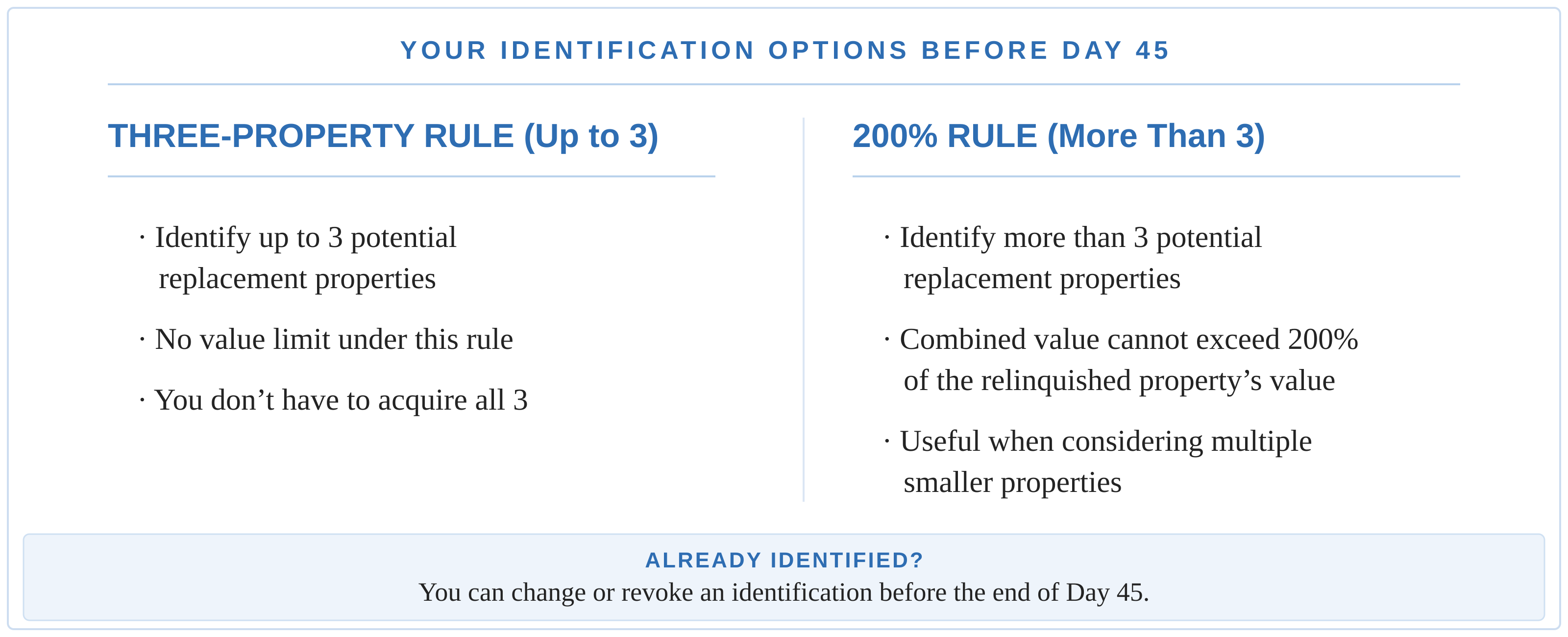
Still not finding the property you want? Broaden the search.
The replacement property you ultimately acquire doesn’t necessarily have to look like the property you sold. Depending on what you’re trying to accomplish, your search might include a different type of investment property or more passive real estate options such as a Delaware Statutory Trust (DST), Tenant in Common (TIC) interest, or triple-net property.
The point isn’t to buy something just because the clock is running. It’s to make sure you understand what your options are before the clock runs out.
Finding a property isn’t the same as identifying it.
Your replacement property must be identified in writing and described unambiguously. An address or legal description can satisfy the requirement. A purchase agreement can also constitute an identification.
And if you’ve already identified a property that no longer works, the identification can be revoked before the end of the 45-day period. By the deadline, however, your final identification needs to fall within the applicable identification rules.
So what should you do if it’s Day 30?
Talk with your Qualified Intermediary about where your identification stands and what options you still have. If you’re relying on one property, this is the time to seriously evaluate alternatives. If you’ve already identified property that no longer makes sense, address it before the identification period ends.
David and Tom have long approached replacement-property planning this way: the property should fit the investor’s objectives, rather than the investor simply buying whatever happens to be available before the deadline.
If you’re approaching Day 45 and have questions about your identification, call Equity Advantage. We’ll help you understand the identification rules and where you are in the process.
Learn More About Identification Rules
The Guys With All The Answers…
 David and Thomas Moore, the co-founders of Equity Advantage & IRA Advantage
Whether working through a 1031 Exchange with Equity Advantage, acquiring real estate with an IRA through IRA Advantage or listing investment property through our Post 1031 property listing site, we are here to help Investors get where they want to be. Call them today! 503-635-1031.