What happens when you’ve spent decades building real estate wealth, but you’re ready to stop managing it?
For many longtime property owners, the next chapter isn’t about acquiring another building. It’s about enjoying what they’ve built, reducing management responsibilities, and planning for the future.
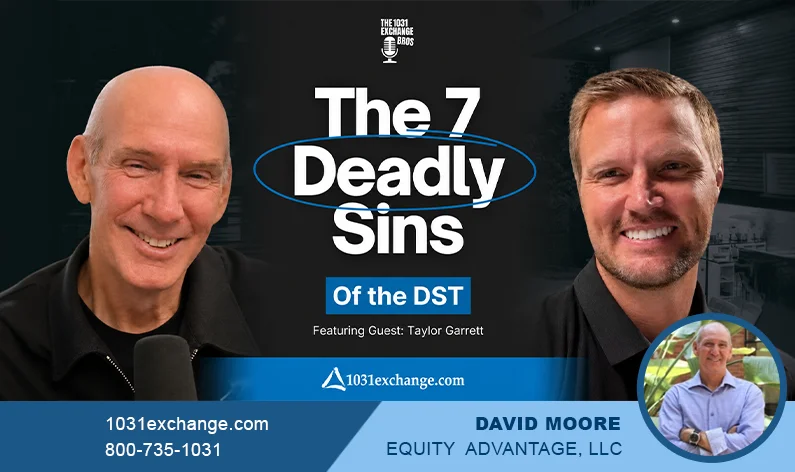
In our latest Blogcast, Equity Advantage’s David Moore sits down with Taylor Garrett of Mountain Dell Consulting and Orchard Securities to discuss Delaware Statutory Trusts (DSTs), the seven restrictions investors should understand, and how 1031 exchanges and Section 721 strategies may fit into their long-term goals.
What Are the 7 Deadly Sins of the DST?
A Delaware Statutory Trust can allow investors to exchange into professionally managed real estate without the day-to-day responsibilities of direct ownership. When properly structured, certain DST interests may qualify as replacement property in a 1031 exchange.
But DSTs operate under seven important restrictions, commonly called the Seven Deadly Sins of the DST:
- No additional capital contributions after the offering closes.
- No new or renegotiated debt, subject to limited exceptions.
- No reinvestment of sale proceeds into new property.
- Limited property improvements, with specific permitted exceptions.
- Restrictions on investing cash reserves beyond permitted short-term investments.
- Required distribution of available cash, subject to permitted reserves.
- Restrictions on new or renegotiated leases.
These restrictions are associated with the tax treatment described in IRS Revenue Ruling 2004-86. They’re part of what makes the qualifying DST structure work, but they also limit flexibility when circumstances change.
Taylor offers a memorable analogy: a DST is like a ship setting sail without a rudder. Once it’s underway, there’s limited ability to change course.
That’s why planning, adequate reserves, and choosing the right sponsor matter so much.
Why the Sponsor Matters
Investors aren’t just evaluating a property. They’re relying on the sponsor’s experience, underwriting, and ability to navigate challenges.
Taylor also makes an interesting observation:
“We’re not looking for people that are perfect. Perfect scares me.”
His point? Understanding how a sponsor handled difficult markets can be more revealing than reviewing a track record of successful investments alone.
The conversation also addresses DST liquidity. Passive ownership doesn’t necessarily mean easy access to your money. DST interests are generally illiquid, and selling early may be difficult.
Thinking Beyond the Exchange
For some investors, the goal is no longer to double or triple their money. It’s to generate income, reduce management responsibilities, and enjoy what they’ve built.
Taylor cites research from Tiburon estimating that baby boomers and the Silent Generation hold approximately $48 trillion in investment real estate, with roughly $23 trillion potentially qualifying for 1031 exchange treatment as wealth transfers to the next generation through 2050.
But the numbers only tell part of the story.
Six children are inheriting the family farm. Some want to keep farming, others want to sell or develop the property, and one needs the money now. Same property, different priorities.
It’s a reminder that planning for the future involves more than simply deciding who inherits the real estate.
Watch the Full Conversation
Whether you’re considering a DST as replacement property or helping a client evaluate their options, David and Taylor offer practical insights into the opportunities, restrictions, and questions worth asking.
Watch The 7 Deadly Sins of the DST — Full Interview
For some investors, success means acquiring another property. For others, it means spending less time managing the wealth they’ve already built.
The Guys With All The Answers…
 David and Thomas Moore, the co-founders of Equity Advantage & IRA Advantage
Whether working through a 1031 Exchange with Equity Advantage, acquiring real estate with an IRA through IRA Advantage or listing investment property through our Post 1031 property listing site, we are here to help Investors get where they want to be. Call them today! 503-635-1031.
For educational purposes only. Not tax, legal, or investment advice. DST investments involve risks, including liquidity and potential loss of principal. Section 721 strategies have additional tax and investment considerations. Consult qualified advisors before making investment decisions.