
When it comes to a 1031 exchange, finding the right replacement property can feel a bit like searching for a pot of gold. The good news? The IRS has clear rules that guide the journey.
Here’s a quick “lucky guide” to the 1031 Identification Rules so your exchange stays on the right path.
Want a deeper explanation of these rules? Watch the full episode below.
Every 1031 exchange has two key deadlines:
45 Days – The Identification Period
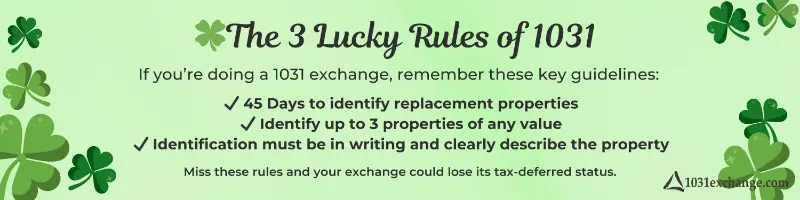
You have 45 days after closing on your relinquished property to identify potential replacement properties in writing.
180 Days – The Exchange Period
You must complete the purchase of your replacement property within 180 days of selling your relinquished property.
These timelines begin when escrow closes and do not extend for weekends or holidays.
🍀 The Three Property Rule (Your Lucky Trio)
Most investors follow the “Three Property Rule,” which allows you to:
• Identify up to three properties of any value
OR
• Identify more than three properties if their total value does not exceed 200% of the relinquished property value
🍀 Don’t Leave It to Luck: Identification Rules
Your property identification must:
✔ Be submitted in writing
✔ Be delivered to a party involved in the exchange (typically your Qualified Intermediary)
✔ Clearly identify the property by address or legal description
✔ Be submitted before the end of the 45-day period
No purchase agreement is required at the time of identification, but if one exists, it can serve as the identification.
🍀 Can You Change Your Mind?
Yes! During the 45-day period you can modify or revoke identifications in writing. Just remember that by day 45, your final list must meet the identification limits.
🍀 What About Property Under Construction?
Properties that are being built can still qualify if they are:
- Identified with as much detail as possible
- Substantially the same property when received
- Valued based on the estimated fair market value when acquired
🍀 A Quick Reminder
IRS identification rules were established in Treasury Regulations effective April 1991 and apply to most exchanges (excluding reverse exchanges). Because every exchange is unique, exchangors should confirm procedures and deadlines with their legal or tax advisors.
Need help navigating your 1031 exchange treasure hunt?
Our team at Equity Advantage is here to help guide you every step of the way. Wishing you luck, prosperity, and successful exchanges this St. Patrick’s Day!
— The Equity Advantage Team